

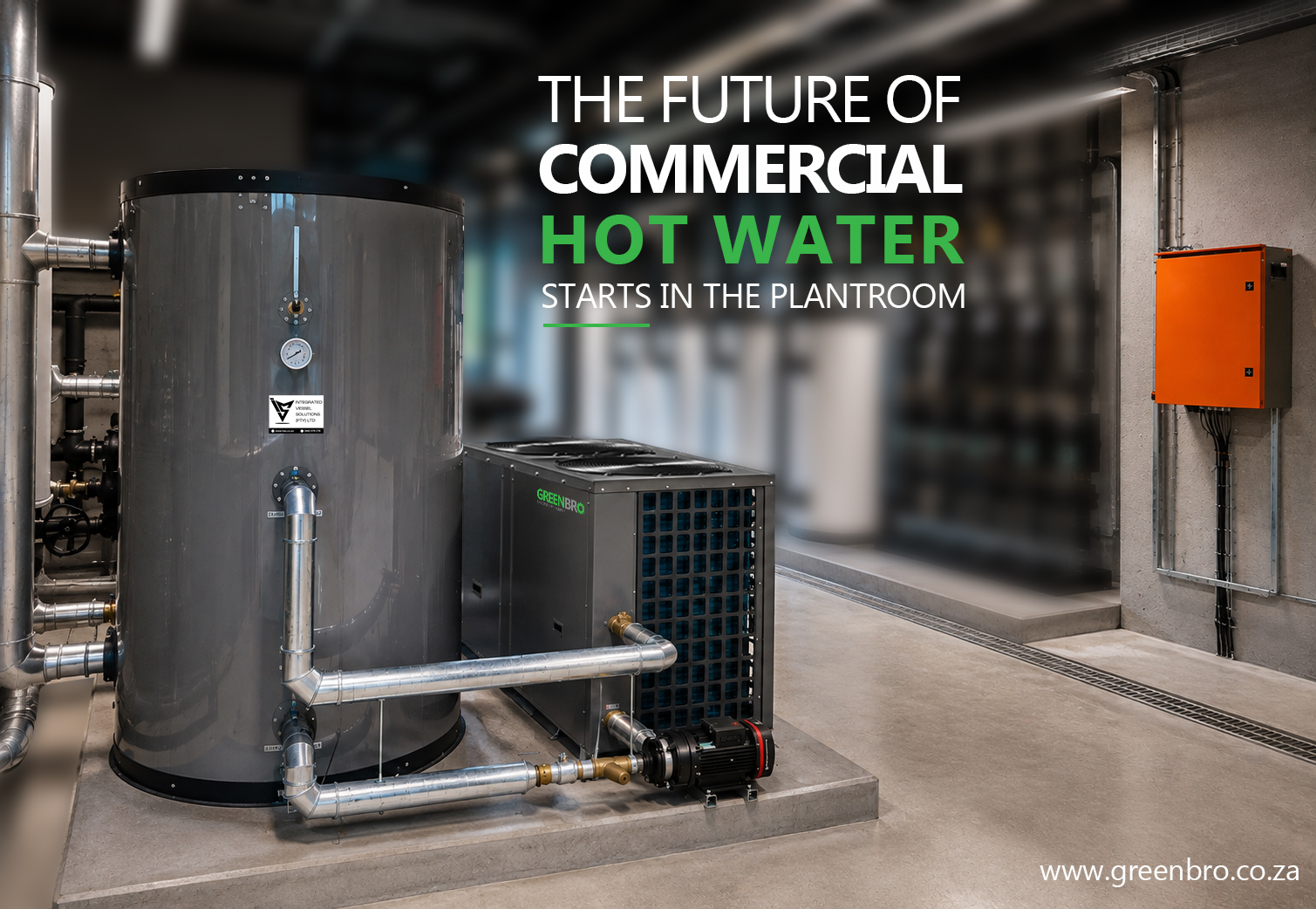
When businesses look for ways to reduce the energy required to produce hot water, the conversation often starts with one piece of equipment: the heat pump.
And while selecting the right heat pump is important, there is a much bigger picture.
A heat pump does not operate in isolation.
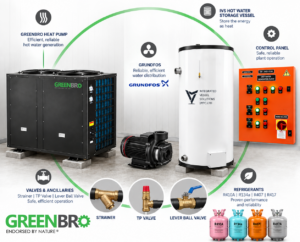
The performance, reliability and efficiency of a commercial hot water system depend on how the entire plantroom works together — from heat generation and thermal storage to circulation, controls, pipework, monitoring and ongoing maintenance.
At Greenbro, we believe this whole-system approach is where the future of commercial hot water lies.
Think of a commercial hot water plantroom as an interconnected system.
Heat Generation → Thermal Storage → Circulation → Distribution → Controls → Monitoring
Every component influences the next.
A high-efficiency heat pump installed into a poorly designed system will not automatically produce an efficient plantroom.
Incorrect water flow, inadequate storage, poor insulation, unsuitable circulation pumps, excessive cycling, incorrect temperature settings or ineffective control strategies can all influence how the system performs.
This is why commercial hot water should be approached as a complete engineered system rather than a collection of individual products.
The heat pump remains the heart of many modern commercial hot water systems, as it is your ultimate heat source.
But bigger isn’t necessarily better.
Selecting the correct equipment requires understanding the building’s actual hot water requirements, including:
Hotels, hospitals, apartment developments, student accommodation and other commercial facilities can have dramatically different consumption patterns.
The objective should therefore not simply be to install the largest possible heat pump.
It should be to design a system where the heat generation capacity and thermal storage work together to meet the building’s actual demand efficiently.
One of the most important components in a commercial hot water plantroom is often the one receiving the least attention: thermal storage.
A properly designed heat accumulator or storage vessel allows thermal energy to be generated and stored for use when demand increases.
Instead of requiring the heat pumps to instantaneously meet every peak in demand, the system can build up stored thermal energy and release it when required.
This can help:
For facilities with significant morning or evening peaks, this relationship between heat generation and storage capacity becomes particularly important.
Even correctly sized heat pumps and storage vessels depend on something very simple:
Water needs to move through the system correctly.
Primary circulation pumps move water between the heat source and thermal storage, while secondary and ring-main pumps ensure hot water reaches the areas where it is needed.
Pump selection, flow rates, pipe sizing and system resistance all influence performance.
An incorrectly designed hydraulic system can result in poor heat transfer, unnecessary electrical consumption, temperature inconsistencies and additional wear on equipment.
Good plantroom design therefore considers the entire hydraulic circuit — not just the equipment connected to it.
If the heat pump is the heart of the plantroom, the control system is its brain.
Modern commercial systems need to know more than simply when to switch equipment ON or OFF.
A properly designed control strategy can coordinate multiple heat pumps, circulation pumps, temperature sensors, backup heating and storage.
Depending on the system, controls can also manage:
The objective is simple: allow the different components within the plantroom to operate as one coordinated system.
Commercial plantrooms are also becoming increasingly connected.
Remote monitoring and intelligent controls can provide greater visibility into system operation, allowing facility managers and service teams to understand what is happening without waiting for a complete loss of hot water.
Depending on the monitoring system, information could include temperatures, equipment status, operating conditions, faults and historical performance.
This represents an important change in how commercial hot water systems are managed.
Instead of only reacting when equipment fails, plantroom data can help identify developing problems earlier and support more proactive maintenance.
The future plantroom isn’t simply producing hot water.
It’s communicating.
Even the best engineering and equipment can be compromised by poor installation.
Pipework layout, insulation, sensor positioning, electrical installation, control settings, equipment clearances and commissioning all influence the final result.
Commissioning is particularly important because it is where the theoretical design meets the real building.
Actual temperatures, flow rates, equipment operation and control sequences need to be checked to ensure the complete system operates as intended.
A commercial hot water plantroom is expected to operate every day, often under demanding conditions.
Hotels need hot water when guests wake up.
Hospitals cannot simply wait for hot water production to resume.
Residential developments expect consistent supply across hundreds of occupants.
That makes maintenance and technical support part of the overall system — not an afterthought.
Regular servicing, system inspections, preventative maintenance and access to knowledgeable technical support can help protect the investment and maintain performance throughout the life of the plantroom.
The commercial hot water industry is changing.
Heat pump technology will continue to develop. Controls will become smarter. Monitoring will become more sophisticated. Thermal storage will play an increasingly important role in managing energy and peak demand.
But ultimately, the greatest gains will come from ensuring these technologies work together.
That means moving away from asking:
“Which heat pump should we install?”
and starting with the bigger question:
“How should we design the complete hot water system?”
At Greenbro, that is exactly how we approach commercial hot water.
From design and equipment selection to heat pumps, thermal storage, pumps, control panels, installation, commissioning, maintenance and after-sales support, we look at the plantroom as one integrated system.
Because the future of commercial hot water isn’t just about better equipment.
It’s about building better plantrooms.
Share this article



Latest 5 projects here