Beyond the Heat Pump: The Real Cost of Running a Commercial Hot Water Plantroom
When businesses look for ways to reduce the cost of producing hot water, the conversation often starts with one piece of equipment: the heat pump.
But an efficient heat pump does not automatically create an efficient hot water system.
In hotels, hospitals, apartment buildings, student accommodation and other commercial facilities, hot water is produced by a complete mechanical system. Heat pumps, storage vessels or heat accumulators, circulation pumps, pipework, controls, backup heating, insulation and operating temperatures all influence how much energy the plantroom ultimately consumes.
With electricity costs continuing to rise, understanding whole-system efficiency is becoming increasingly important.
Electricity Costs Continue to Put Pressure on Operating Budgets
For the 2026/27 financial year, Eskom’s standard prices for directly supplied customers increased by an annual average of 8.76% from 1 April 2026, while tariffs for municipal bulk electricity purchases increased by an average of 9.01% from 1 July 2026.
It is important to note that the 9.01% relates to municipal bulk purchases from Eskom and does not necessarily represent the final tariff increase experienced by every municipal electricity customer. Municipal end-user tariffs can differ.
For commercial property owners and facility managers, however, the broader message remains important:
Reducing electricity consumption is not simply about purchasing more efficient equipment. It is about understanding how the entire hot water plantroom operates.
A relatively small inefficiency repeated 24 hours a day, 365 days a year can become a significant operating expense.
1. Whole-System Efficiency
The efficiency of a mechanical hot water plantroom is determined by how well its individual components work together.
A highly efficient heat pump can still form part of an inefficient system if:
- the heat pump is incorrectly sized;
- hot water storage is insufficient or excessive;
- circulation pumps operate unnecessarily;
- pipework loses excessive heat;
- control settings cause equipment to cycle excessively;
- operating temperatures are unnecessarily high;
- backup electric heating operates more frequently than intended; or
- equipment is poorly maintained.
This is why plantroom design should start with the building’s actual hot water demand rather than simply selecting equipment according to capacity.
Daily demand, peak demand, recovery periods, storage capacity, ambient conditions and operating temperatures should all form part of the design.
2. Thermal Storage: Store the Energy as Heat
One of the most interesting developments in energy-efficient hot water design is the growing focus on thermal energy storage.
The principle is surprisingly simple.
Instead of producing all the hot water at exactly the moment it is required, an appropriately designed system can produce and store thermal energy in advance.
A heat accumulator or hot water storage vessel effectively becomes an energy reservoir.
Heat Pump → Thermal Storage → Building Demand
This can allow the heat pumps to recover stored hot water between periods of high demand rather than requiring the system to meet every peak instantaneously.
Thermal storage can also provide opportunities to manage when energy is consumed, particularly where the hot water demand profile allows stored thermal energy to be produced ahead of periods of high demand.
According to the International Energy Agency’s Heat Pump Monitor 2026, thermal storage can provide flexibility by allowing heat-pump electricity consumption to be shifted away from certain peak periods.
For commercial hot water applications, this makes the relationship between heat pump capacity and storage capacity particularly important.
Bigger heat pumps are not always the answer.
Sometimes correctly sized storage and better overall system design can be more valuable than simply installing additional heating capacity.
3. Refrigerants Are Becoming Part of the Efficiency Conversation
The refrigerant industry is also changing.
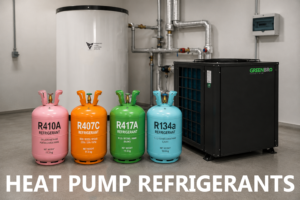
South Africa continues to implement its commitments under the Montreal Protocol and Kigali Amendment, which introduces controls aimed at reducing the consumption of hydrofluorocarbons (HFCs) with high global warming potential.
In March 2026, South Africa’s Department of Forestry, Fisheries and the Environment confirmed that the country’s Kigali Implementation Plan will guide policy measures, technical assistance and technology transition within the sector, with particular emphasis on energy efficiency and environmentally friendly refrigerant alternatives.
For building owners, consultants and contractors, refrigerant selection will therefore increasingly form part of long-term equipment decisions.
But refrigerant choice should not be considered in isolation.
Safety requirements, operating pressure, equipment design, efficiency, servicing requirements, technician competency, refrigerant availability and environmental impact all need to be considered.
The transition also places greater importance on correct servicing practices. The Department specifically highlights the role of trained refrigeration and air-conditioning technicians in preventing refrigerant losses, reducing unnecessary recharging and improving system efficiency.
This makes correct equipment selection and professional maintenance increasingly important throughout the equipment’s operating life.
4. Maintenance Is an Energy-Efficiency Issue
Maintenance is often viewed primarily as a way of preventing breakdowns.
It should also be viewed as part of energy management.
Heat exchangers, evaporator coils, filters, pumps, sensors, valves and control systems all need to operate correctly for a plantroom to perform efficiently.
For example, poor heat transfer may require a heat pump to operate for longer periods to achieve the required water temperature.
Incorrect sensors or control settings may result in unnecessary cycling.
Problems with circulation may cause heat to be continuously lost throughout the building’s hot water ring main.
The plantroom may still produce hot water — but it may be using considerably more electricity than necessary to do so.
This is why preventative maintenance should not only ask:
“Is the equipment still working?”
It should also ask:
“Is the equipment still operating as efficiently as it should?”
5. Purchase Price vs Lifecycle Cost
Perhaps one of the biggest changes required in how commercial hot water systems are evaluated is moving away from purchase price towards lifecycle cost.
The cheapest plantroom to install is not necessarily the cheapest plantroom to own.
Lifecycle cost considers more than the initial equipment price.
It includes:
Capital Cost + Energy Consumption + Maintenance + Repairs + Component Replacement + Expected Equipment Life
A mechanical hot water plantroom operates for many years.
That means electricity consumption, maintenance requirements, component availability, reliability and system longevity can ultimately have a much greater financial impact than a difference in the original purchase price.
This is particularly important for facilities with substantial hot water demand, where equipment may operate for many hours every day.
The Future Is the Complete Plantroom
The future of commercial hot water is therefore not simply about finding a more efficient heat pump.
It is about creating a more efficient hot water system.
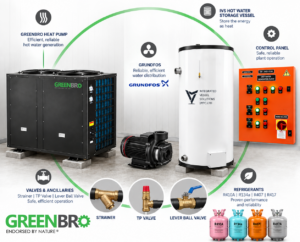
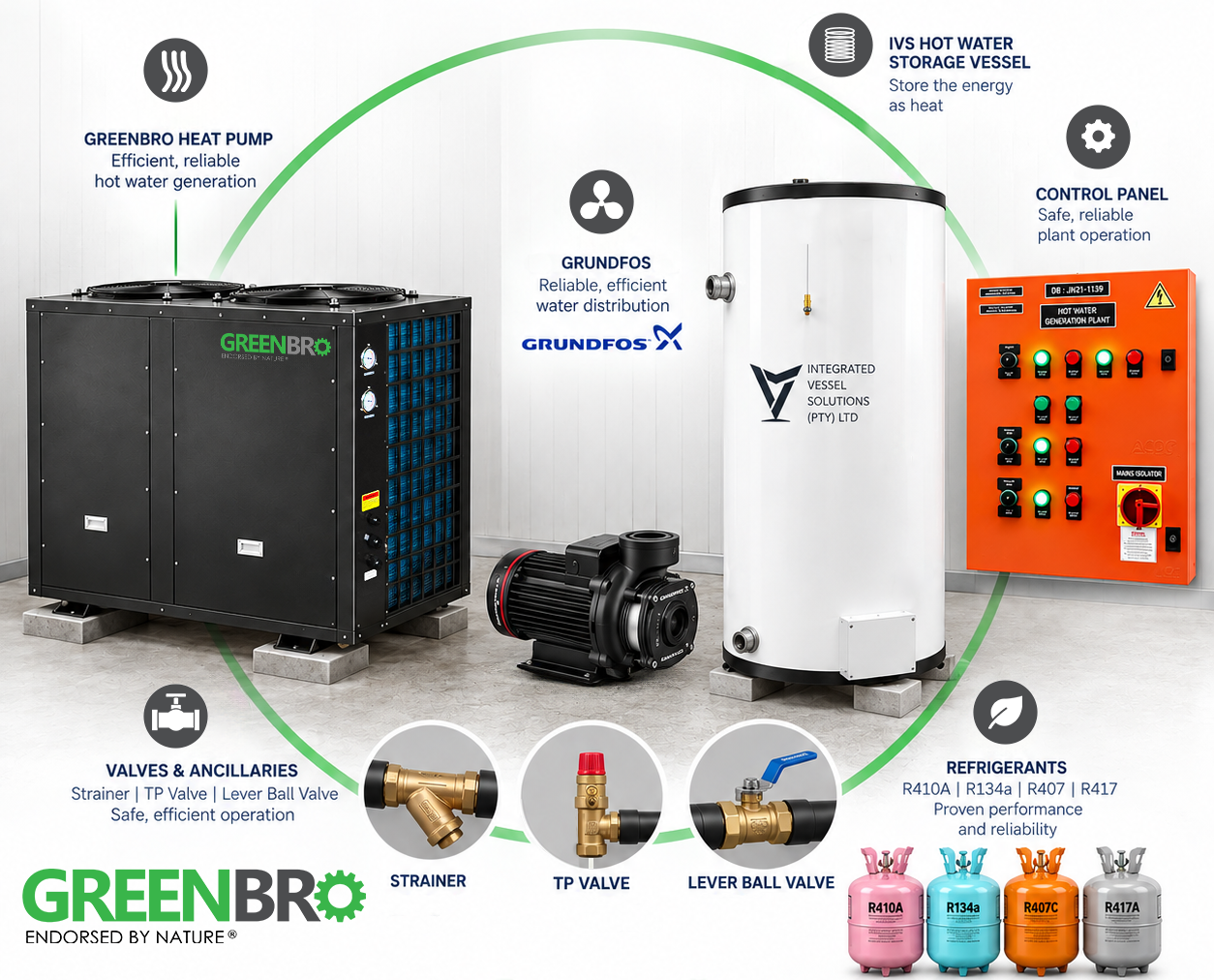
Heat pump technology, thermal storage, correctly selected circulation pumps, effective controls, insulation, appropriate refrigerants and preventative maintenance all contribute to the overall performance of the plantroom.
At Greenbro South Africa, we believe mechanical hot water systems should therefore be approached as complete plantrooms rather than individual pieces of equipment.
Because ultimately, the question shouldn’t only be: “How efficient is the heat pump?”
The better question is: “How efficiently is the entire plantroom producing, storing and delivering hot water?”