Turn down the temperature and save energy.
It sounds logical.
After all, the higher we heat water, the more energy is required. So surely lowering the temperature of a commercial hot water system is an easy way to improve efficiency?
Not necessarily.
In commercial hot water systems, temperature isn’t determined by energy efficiency alone. Water hygiene, storage, circulation, system design and the way the building uses hot water all need to be considered.
And this is where 60°C becomes an important number.
Why Does Hot Water Temperature Matter?
Commercial hot water systems can contain hundreds or even thousands of litres of stored water, together with extensive pipework distributing that water throughout a building.
Hotels, hospitals, apartment buildings, student residences and similar facilities may also have ring-main systems continuously circulating hot water so that it is available close to the point of use.
If parts of these systems remain at favourable temperatures for long periods, they can create conditions in which microorganisms can survive and multiply.
One of the best known is Legionella.
Legionella bacteria occur naturally in freshwater environments, but certain man-made water systems can provide conditions that allow them to multiply.
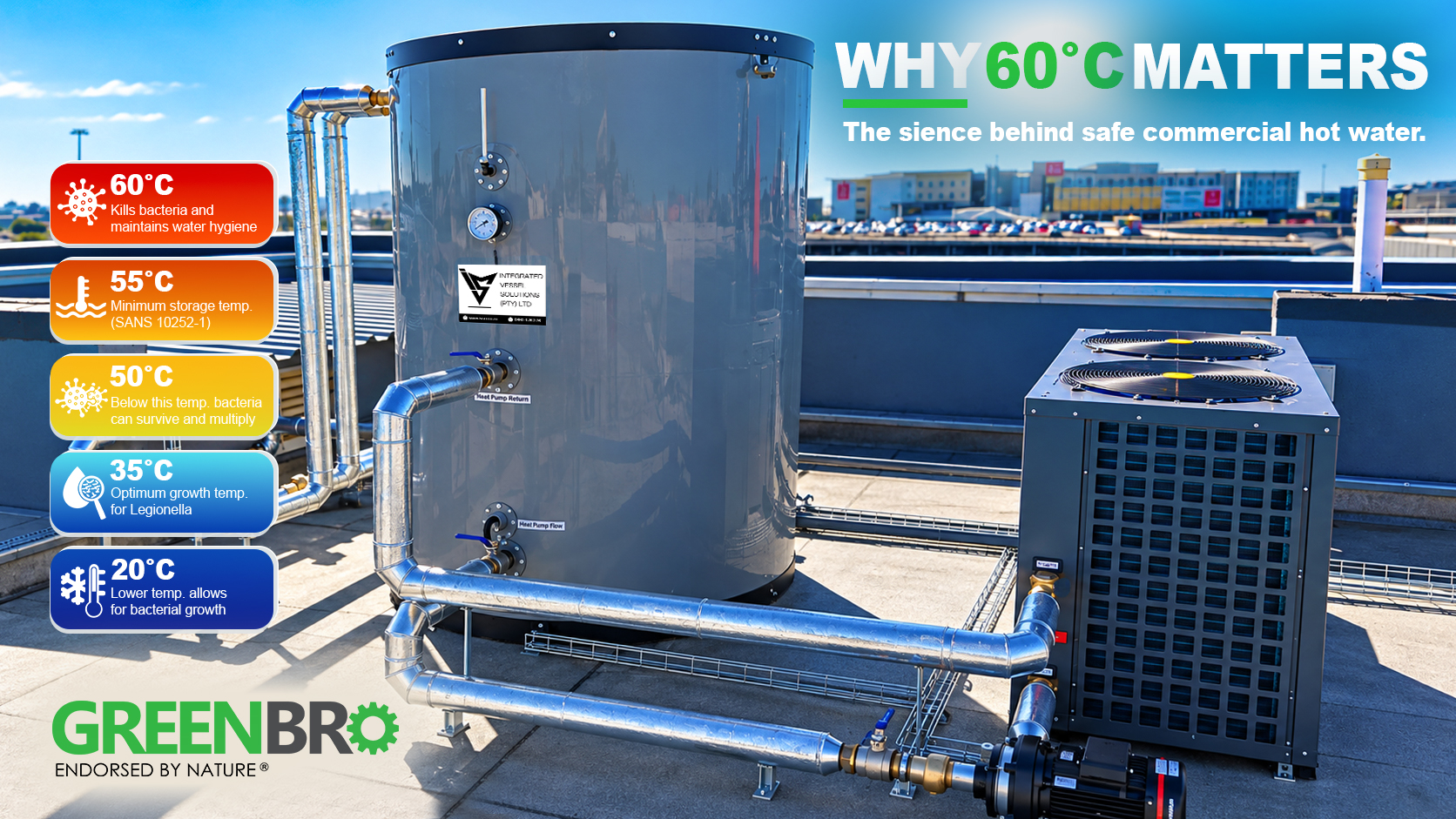
According to the World Health Organization, Legionella can grow in water temperatures between approximately 20°C and 50°C, with optimum growth occurring around 35°C.
This is one of the reasons temperature management plays such an important role in hot water system design.
So Why 60°C?
South African hot water installation guidance provides an important reference point.
SANS 10252-1 states that stored hot water should be maintained at a temperature of at least 55°C, while reaching 60°C for at least one hour per day.
South African guidance relating specifically to Legionella management also places importance on controlling hot water temperatures around or above 60°C.
But there is an important distinction: Setting a heat pump, inline heater or storage vessel to 60°C does not automatically mean the entire hot water system is at 60°C.
And that’s where things become more interesting.
60°C at the Tank Doesn’t Mean 60°C Everywhere
Imagine a large hotel with a central hot water plantroom.
Water may leave the storage vessel at the required temperature, travel through hundreds of metres of pipework, circulate around several floors and eventually return to the plantroom.
During that journey, heat is lost.
Poorly insulated pipework, long distribution routes, incorrect circulation rates, dead legs and sections of stagnant water can all result in different temperatures throughout the system.
This means there can be a significant difference between: Storage temperature → Flow temperature → Circulation temperature → Return temperature → Temperature at the outlet
That is why good hot water design considers the entire water circuit, not simply the temperature displayed on the heating equipment.
Stagnation Matters Too
Temperature isn’t the only consideration.
Water movement is equally important.
Sections of pipework that are rarely used can allow water to remain stagnant for extended periods.
This can happen in unused hotel rooms, seasonal facilities, seldom-used bathrooms or sections of buildings that have been altered without redundant pipework being properly removed.
International guidance on Legionella control therefore doesn’t only focus on temperature. It also recommends reducing stagnation and regularly flushing outlets that aren’t frequently used.
Good hot water hygiene is ultimately about controlling the environment inside the entire water system.
Then Why Not Just Heat Everything Much Hotter?
If higher temperatures help control bacterial growth, it might seem logical to simply operate the system at 70°C or even higher.
But that introduces another set of considerations.
Higher water temperatures generally mean: More energy is required.
For a heat pump, increasing the required leaving-water temperature also increases the temperature lift the system has to achieve. Depending on operating conditions and equipment design, this can affect efficiency.
Higher temperatures can also increase standing heat losses from storage vessels and distribution pipework.
And importantly, very hot water presents a scalding risk at the point of use.
This is why hot water engineering is a balancing act.
The goal isn’t simply: “Make the water as hot as possible.”
It’s to produce and maintain hot water at appropriate temperatures while balancing hygiene, safety, efficiency and availability.
Storage Temperature and Outlet Temperature Are Not Necessarily the Same
This is another common misconception.
Water may need to be stored and circulated at temperatures required by the system’s hygiene strategy, but that does not necessarily mean water must reach the user at that same temperature.
Where appropriate, thermostatic mixing valves can mix hot and cold water closer to the point of use to provide a safer delivery temperature.
This allows the hot water system to maintain the required thermal conditions while reducing the risk of excessively hot water being delivered to taps and showers.
The exact approach depends on the building, its application and applicable requirements.
What About Heat Pumps?
This is where heat pump selection becomes particularly important.
Not every heat pump is designed to produce the same leaving-water temperature.
Some systems are optimised for approximately 55°C operation, while constant-temperature and high-temperature heat pumps can operate at considerably higher water temperatures.
The required hot water temperature therefore needs to be considered during the design stage, not after equipment has already been selected.
A commercial hot water system should consider:
- required storage temperature;
- peak hot water demand;
- storage volume;
- recovery period;
- heat pump capacity;
- achievable leaving-water temperature;
- circulation and return temperatures;
- pipework heat losses;
- backup heating requirements; and
- the building’s usage profile.
These factors influence one another.
Hospitals and Healthcare Facilities Require Particular Attention
Hot water hygiene becomes especially important in healthcare environments.
Hospitals and other healthcare facilities may accommodate individuals who are more vulnerable to infection.
Recent South African research into opportunistic pathogens in hot water systems specifically highlights healthcare facilities as environments of concern and stresses the importance of appropriate water-system management.
Hotels, retirement facilities, large residential developments and other buildings with extensive central hot water networks should similarly understand how their water is being stored and distributed.
Good Hot Water Design Is About More Than Heating Water
A well-designed commercial hot water system doesn’t simply answer the question: “How many kilowatts of heating do we need?”
It needs to consider what happens to that hot water after it has been produced.
- How much should we store?
- How quickly must we recover it?
- At what temperature should it be stored?
- How far does it travel?
- What temperature returns to the plantroom?
- Are there areas where water can stagnate?
- Is the circulation system correctly sized?
- How effectively is the pipework insulated?
- How is the end user protected from excessively high temperatures?
These are all part of commercial hot water design.
The 60°C Question Is Really a System Question
There isn’t one piece of equipment responsible for maintaining a healthy and efficient hot water system.
- The heat pump produces the heat.
- The storage vessel or heat accumulator stores thermal energy.
- The circulation system moves the water.
- The pipework distributes it.
- The controls manage operation.
- And the design brings everything together.
So when we talk about 60°C, we’re really talking about something much bigger: How do we design a commercial hot water system that balances water hygiene, safety, performance and energy efficiency?
That is where proper mechanical hot water system design becomes essential.